The short answer
Service may not sell you this car; it decides whether you buy the next one there. We asked buyers on r/carbuying whether a dealership's service department factors into where they buy, and whether they would pay $500 more for a dealer with no service headaches. Thirty-three buyers answered directly and split 17 to 16. But the loyalty data on the purchase after this one is not split at all.
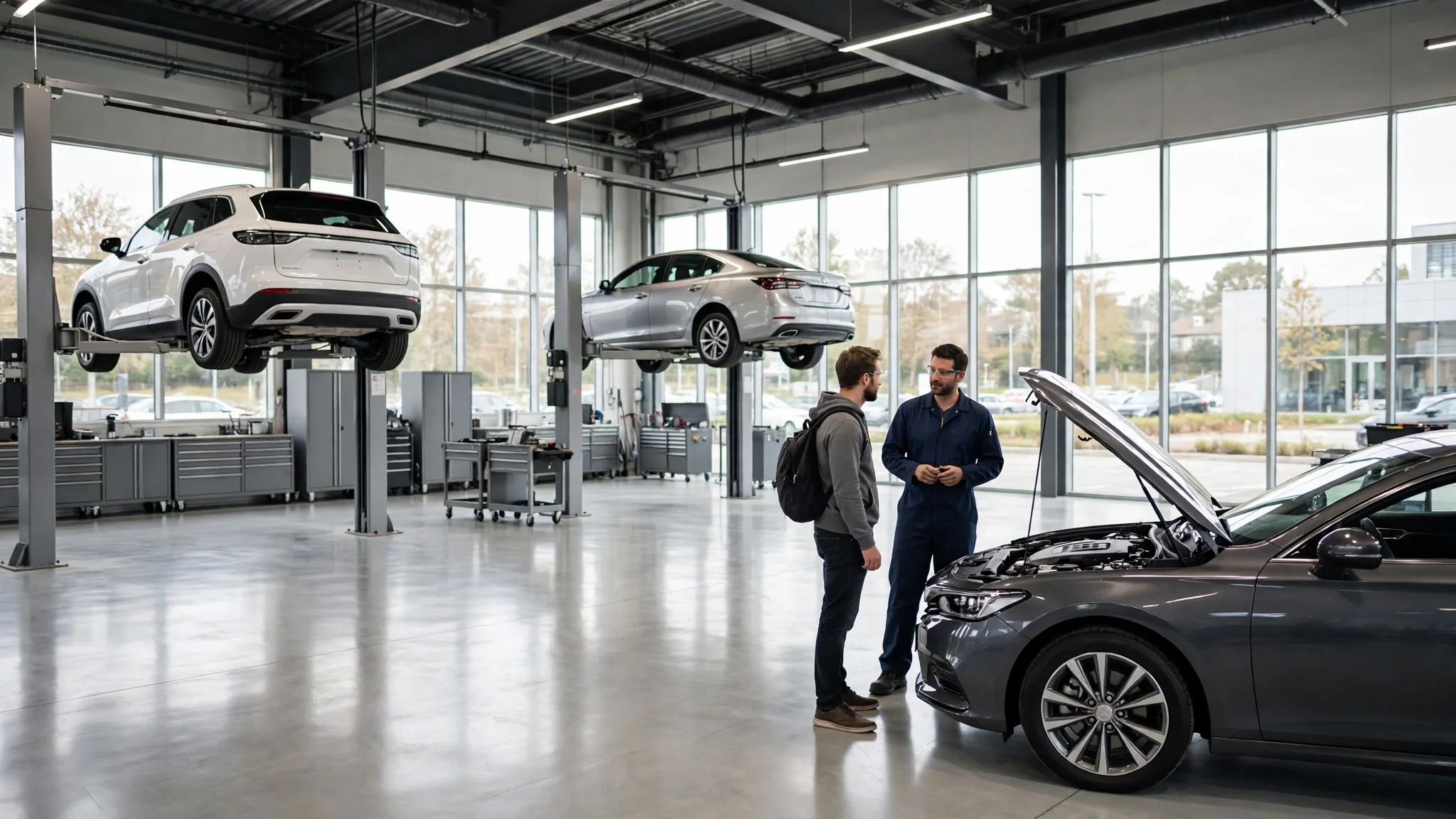
The question was ours. CarThrive posted it on r/carbuying under its own account after calling a dealership for a service appointment and being quoted a two-week wait. It turns out the buyers who answered are really having two different arguments, and both sides win theirs. The split runs along four lines: how much warranty exposure the car carries, how many dealers are within reach, whether you ever use dealer service after the warranty, and what segment you buy in. Filter the answers and the pattern shows itself.
The warranty is the leash
The thread's most upvoted answer was a qualified yes: unless the car is under warranty, that buyer never visits a dealership for service. While the warranty runs, the service department is not optional, so its reputation is part of what you are buying whether you shop for it or not.
It matters most on the brands you would expect
One buyer named Kia, Hyundai, and Chrysler/Jeep/Dodge: hard to get the car in, visits that stretch for days, loaners that rarely exist. A 10-year warranty is only worth what the service lane can deliver. These are individual anecdotes from the thread, not brand rankings, but the pattern repeated.
A great department earns the next sale
A Toyota owner described a decade of realistic estimates, photo and video updates during repairs, no upsell pressure, and loaners when needed. He is buying his next vehicle from that store even if it is not the best deal available, and said he would pay hundreds, even thousands, more up front for a service experience he trusts.
Loyalty stories kept repeating
A Subaru owner bought a second car from the brand largely because the service department and the manufacturer handled every issue, after Toyota and Honda stores brushed him off. A Lexus owner stayed loyal after his dealer backed his car into a wall, admitted it on the spot, and made it right. Honesty in the lane did what no discount could.
Geography decides for you
Buyers with four brands in reach, or a 90-minute drive to the alternative, do not get to separate the decisions. When the selling dealer is also the only service department you will ever use, its quality is a feature of the car.
The insider view
A Chrysler service employee said working the lane changed how he buys. Cars sat for days and weeks waiting on repairs, and beyond the diesel trucks, he would not buy the products he services. A technician shortage thread inside the thread blamed the waits on pay and experience, not demand.
The oil-change audition
One buyer's method deserves its own card: before shopping at a dealership, take your current car there for a simple oil change. Watch how the service department treats customers and what games it plays with small jobs. It is the cheapest test of the ownership experience on offer.
Two separate transactions
The top no answer, and the no camp's strongest card: sales and service have no connection. Take the best deal, then service the car wherever you want. Any dealer of the brand can perform warranty work and recalls, as one buyer confirmed after moving states, so a premium paid to the selling dealer buys nothing exclusive.
Never going back
Several buyers service with independent mechanics they trust, or do their own work after the free maintenance period, and called dealer service overpriced. If you will never use the department, its quality cannot be worth a dollar of premium to you.
Buy a car that skips the shop
Reliability-first buyers invert the question. First consideration is a track record of not being in the shop; second is price. Choose the car well and the service department barely enters your life, warranty or not.
Bought online, delivered, done
One buyer has purchased seven vehicles in ten years entirely by email and DocuSign, with delivery, and has never returned to a selling dealer. His checklist is the exact unit, as described, paperwork online, delivered. For remote buyers, the seller's service department is a non-factor by design.
Price and the right car won
Pressed by the original poster on whether service influenced him at all, one buyer who shopped an hour's radius said no: he bought from the dealer he can walk to because it had the color and a good price. Configuration and price, not the service lane.
Buy there, get grace there
The true middle position: you can service anywhere, but if your preferred department is at the selling dealer, buying there can unlock goodwill when something borderline needs handling. Not a guarantee, just a relationship, and for some buyers that is worth something.
Booked out for months
One buyer said he would never buy a Hyundai for service reasons alone: the local departments are so backed up that nothing can be scheduled for months. The brand's service capacity became a reason to cross the car off the list before price was ever discussed.
Converted by a department he did not buy from
An Accord owner moved states and serviced at a local dealer he had not bought from. They were so good to deal with that he would buy from them next time. Service quality can win a sale the sales floor never made, which is the whole argument of the data below in one story.
What the bigger data says
The thread is a split decision about this purchase. Cox Automotive's 2025 ownership research describes the next one, and there the argument is over.
74% vs 44%
Owners who serviced at the dealership say they are likely to buy their next vehicle from that same store, versus owners who never returned for service. A 30-point gap driven by the service lane, not the sales floor.
88%
Of consumers say the service experience directly impacts their likelihood of returning to that dealer for a future purchase.
54%
Of owners of vehicles two years old or newer returned to their selling dealer for service in 2025, down from 72% in 2023. Dealers are leaking the exact visits that produce the next sale.
J.D. Power's Customer Service Index work backs the thread's frustrations. Appointment wait times in 2025 remained longer than the 2018 to 2022 norm, so the two-week booking that prompted our question is unremarkable. Twelve percent of repairs were not fixed right the first time, and only half of those customers returned or planned to return to that dealership. In the 2026 study, customers at the top of the satisfaction scale said they definitely will return for paid service at rates of 86% for mass-market brands and 88% for premium brands.

And the frustration is rarely the hourly rate. Cox found dealership repair costs comparable to independent shops, about $261 versus $275 on average, while dissatisfaction clustered on time and surprise: service taking longer than expected (24%), unexpected costs (13%), upsell pressure (13%), and a final bill above the estimate (12%). The complaints are about transparency, which is the one part of service quality a buyer can check before purchasing.
The $500 question
Asked directly whether they would pay $500 more for a headache-free service department, the thread split the way it split on everything. The yes camp's ceiling ran well past $500: hundreds to thousands more, said the buyer with the trusted Toyota store, and another would pay a bit more for a dealer that ticks every box at once (local, service, reputation, and still a fair price). The no camp would pay nothing, because the premium buys something separable. You can purchase at the cheapest store in the state and service at the best department in town. A service premium only earns its money when the two are chained together: by a long warranty on a car that will use it, by distance, or by a brand whose local service capacity is already strained.
How to use this before you buy
- Call the service department, not the sales floor. Ask how far out they are booking routine service. Days is normal. Weeks is a real cost of ownership you will pay in time, repeatedly.
- Ask about loaners, pickup, and updates. The thread's most loyal owners named loaners, pickup and delivery, and photo or video progress updates more often than price.
- Read the dealer's recent Google reviews with a service eye. Most reviews of a dealership are written by service customers, not buyers, so the Google rating on a dealer's profile is already mostly a service grade. Our dealer profiles carry those Google ratings up front for this reason.
- Run the oil-change audition. One small job on your current car tells you how a department treats people when the stakes are low, before you find out how it behaves when they are high.
- Weight it by brand and warranty. A long warranty plus a strained local service operation is an ownership cost to price in. A trusted independent mechanic, a strong reliability record, or buying fully online makes the selling dealer's service department close to irrelevant.
The bottom line: buy the car on price, configuration, and total cost, including the doc fee and what is actually inside the advertised price. Then choose your service department on purpose, because every dataset we found says that choice, not the purchase, is the one that echoes into your next car.
Method and disclosure: CarThrive asked this question on r/carbuying under its own account in October 2026 and counted the 33 direct answers visible on October 21, 2026 (17 yes, including two warranty-qualified answers, and 16 no). It is a snapshot of one thread, not a survey, and later comments will move the count. Cox Automotive figures are from its 2025 service and ownership research; J.D. Power figures are from the U.S. Customer Service Index studies for 2025 and 2026. CarThrive grades dealers on doc fees and price transparency, not on service quality, and nothing here is a service ranking.